
For years, the direction of travel in data centre networking was clear. More capacity meant more routers, more switches and more network paths. Architectures grew larger, faster and, above all, more complex. But what if scaling up actually calls for less networking hardware?
AWS opts for a flatter structure
AWS recently unveiled its new data centre network architecture: Resilient Network Graphs (RNG). It is a design that departs from the traditional fat-tree architectures on which many modern data centres are built. AWS itself even describes it as a shift from "fat" to "flat".
With RNG, AWS opts for a flatter network structure in which traffic is no longer routed through a limited set of predetermined paths. Using what it calls the Spray Protocol, data flows are distributed across a large number of available paths, allowing capacity to be used more efficiently and congestion to be avoided more effectively.
AI is pushing east-west traffic upwards
The timing is interesting. The rise of AI is driving explosive growth in east-west traffic inside data centres. When training AI models, thousands of GPUs exchange data with one another continuously. That demands networks that are not only fast, but that also keep performing predictably at scale.
For AWS, RNG delivers significant benefits according to its own figures: 69% fewer routers, 33% more network capacity and a 40% reduction in energy consumption. Those are numbers that are hard to ignore. But perhaps the most interesting question is not whether these figures hold up.

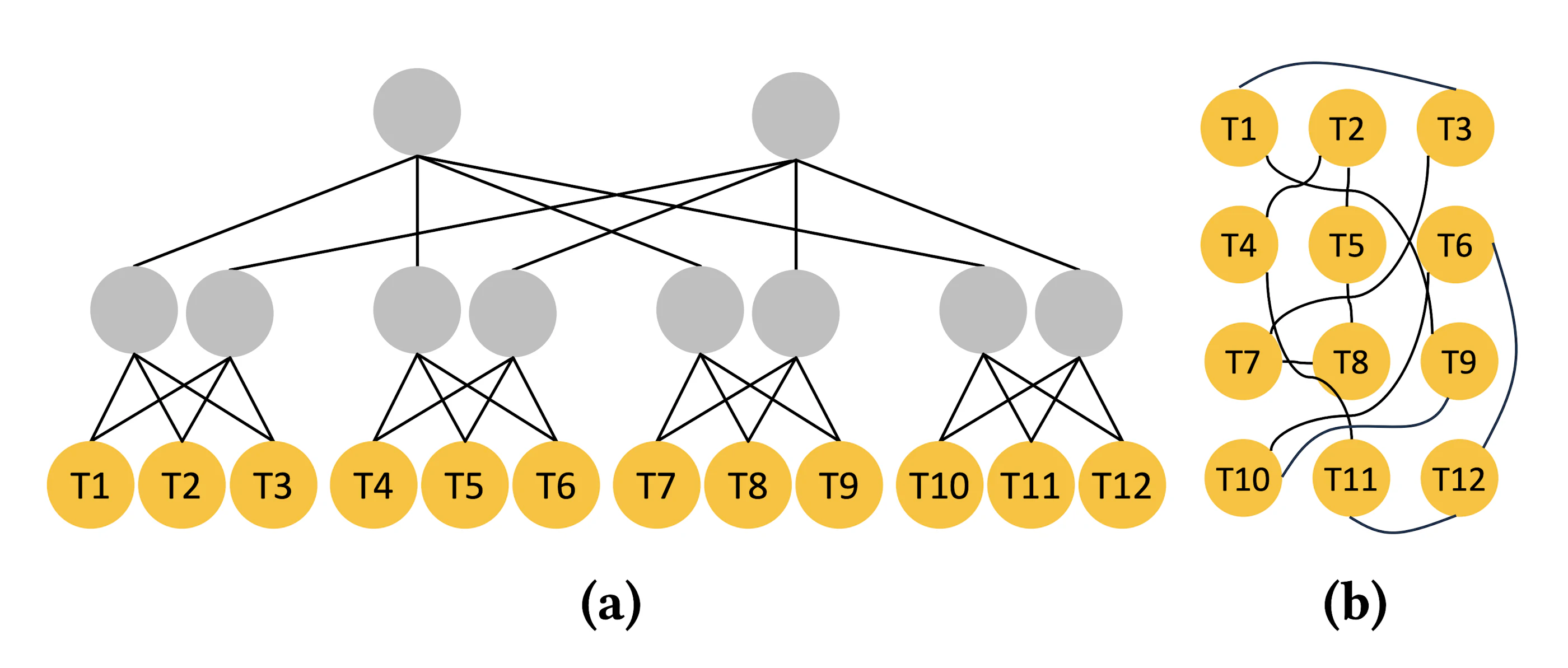
The start of a broader shift?
The real question is whether this is the start of a broader shift in data centre architecture.
History shows that innovations originating with hyperscalers often find their way to the rest of the market in the end. Not immediately, and not always in the same form, but the influence is usually greater than it first appears.
That does not mean organisations will say goodbye to spine-leaf, EVPN or VXLAN tomorrow. Those architectures will remain the foundation of enterprise data centres for years to come.
Even so, it is worth following what is happening here. Because if AI workloads keep growing and east-west traffic accounts for an ever larger share of network traffic, is it inevitable that other players will also start looking for alternatives to the traditional fat-tree?
What does this mean for enterprise data centres?
For enterprise organisations, little is likely to change tomorrow. But when one of the largest data centre operators in the world chooses a fundamentally different direction, it is wise to pay attention.
Not because RNG is the new standard overnight, but because the underlying question is becoming increasingly relevant: are traditional fat-tree architectures still the best way to support the AI workloads of tomorrow?
The coming years will reveal whether AWS is an exception here, or the forerunner of a broader move from fat to flat.
Join us at Nomios Next on 17 September
Do you keep up with all the latest developments in cybersecurity? On 17 September, you’ll be brought up to speed in a single day on quantum security, digital sovereignty, AI in security, geopolitics, identity security, international cybercrime, secure networking and more.
Nomios Next in a nutshell:
- Keynotes by General Dick Berlijn and neurobiologist Brankele Frank.
- Meet experts from Thales, Palo Alto Networks, Okta, Fortinet, HPE, Nokia, Tenable and many other leading cybersecurity companies.
- An English track for our non-Dutch-speaking visitors.
- Conference for 300+ cybersecurity and networking professionals.
- 18 breakout sessions on current topics and developments.
- Prime venue: Corpus Conference Centre, Leiden, Netherlands.
- Includes lunch and a social drinks reception for networking.
Register now and use the discount code NOMBL26 during registration.