
Attackers are moving faster than ever. The time between initial access and full compromise has shrunk to minutes — and more than 90% of all breaches can be traced back to preventable gaps. Limited visibility. Excessive trust. Tools that were never designed to work together. With Cortex XDR 5.0, Palo Alto Networks gives a direct answer to that reality. As a Palo Alto partner, we see these challenges play out in practice every day. Here's what the new release changes.
The endpoint as the core of your defence
Attacks land on the endpoint, move laterally from there, and leave their clearest traces there too. But endpoint visibility alone isn't enough — sophisticated attacks spread simultaneously across devices, identities, applications and data, hiding precisely in the blind spots between tools. XDR 5.0 treats your entire environment as a single connected attack surface. That's not a marketing promise, but an architectural decision that goes to the heart of the platform.
The key innovations
AI agents that actually take work off your plate
The most impactful part of this release is the native integration of AgentiX: a framework of AI agents that autonomously handle triage, enrichment and host containment. Not as an experiment, but as an operational part of your SOC — 24/7, with a full audit trail and human-in-the-loop approval for high-impact actions. A no-code agent builder makes it possible to configure agents for your specific environment, without developer input. What used to take half a working day becomes a matter of minutes.
An analyst experience that thinks along with you
The case management interface has been rebuilt from the ground up. AI-driven summarisation translates complex alerts into plain language. Visualisations map connections between alerts, assets and users. A built-in Agentic Assistant actively suggests next steps during an investigation. And a new Resolution Center consolidates all remediation actions in one place — no more handoffs between investigation and response.
Stopping data loss before it leaves
Endpoint DLP is now available as an add-on and takes a refreshingly different approach from traditional DLP tools. Classification happens entirely on the endpoint itself — sensitive data never leaves the device for scanning, even when offline. When a policy is violated, the agent doesn't just block the action — it explains to the user why. This turns a potential incident into a learning moment, and reduces false positive rates for the SOC.
Exposure management without standalone tools
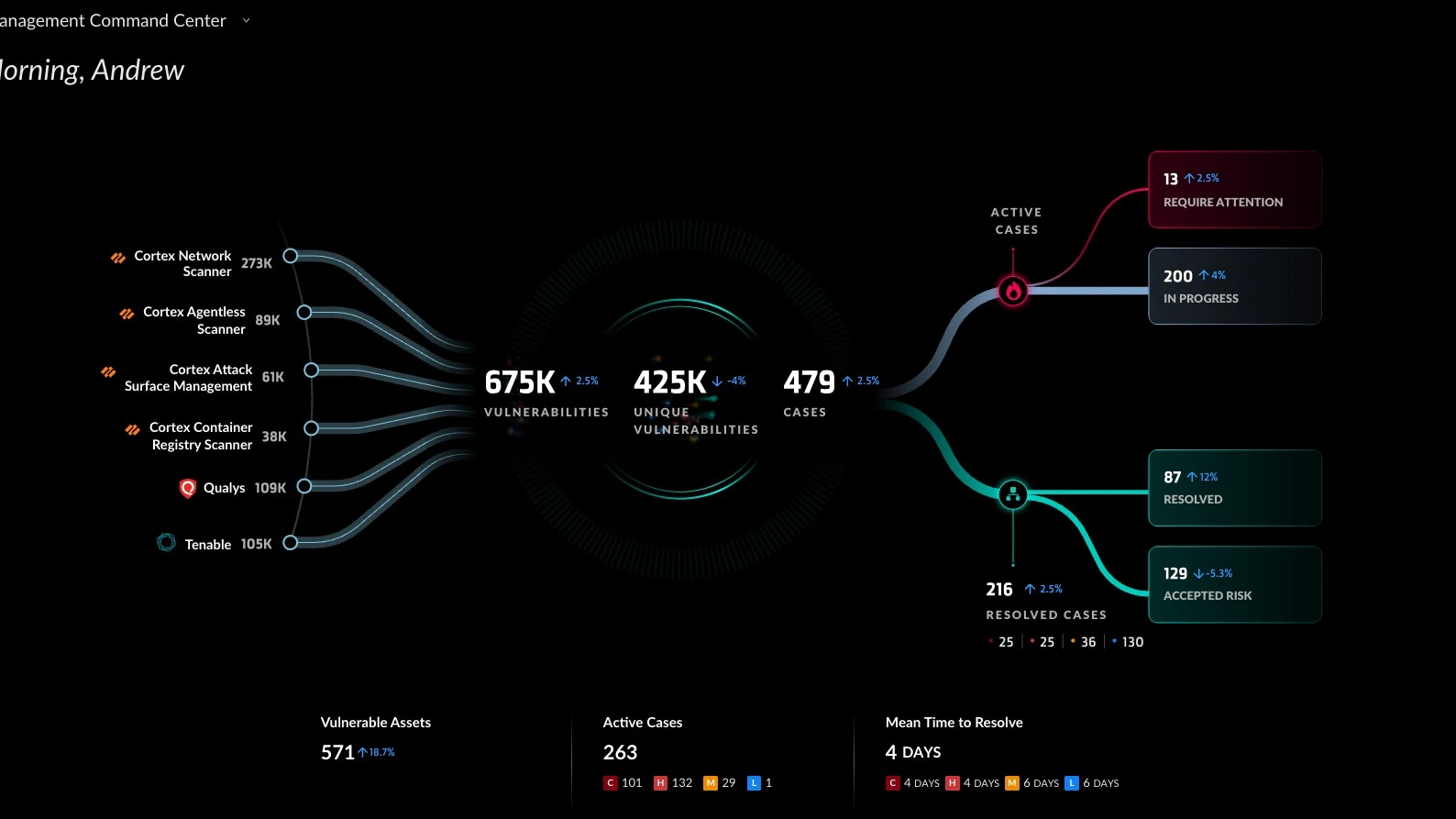
In practice, vulnerability management too often means switching between systems and correlating data manually. XDR 5.0 combines deep endpoint assessments with network, external and third-party scans in a single interface. AI-driven prioritisation links vulnerabilities to exploitability and business context. Virtual patches and compensating controls can be applied directly from the same workflow.
Stronger protection for Linux and macOS
Security shouldn't depend on the operating system. XDR 5.0 introduces on-write protection for ELF, PE and Mach-O files: malicious binaries are blocked before they're even stored. Combined with behavioural analytics for credential harvesting and network baseline profiling for both platforms — so anomalous behaviour becomes immediately visible.
Email security with more stopping power
Email remains one of the most exploited entry vectors. The Advanced Email Security add-on gets a new Command Center providing real-time insight into the health of the email environment, complemented by an automated remediation process based on predefined policies. Malicious emails are neutralised before users can interact with them.
What does this mean for your organisation?
Cortex XDR 5.0 is not an incremental update. The platform shifts from reactive detection to proactive defence — with AI agents taking over operational tasks, exposure management closing gaps before attackers can exploit them, and an analyst experience built around speed and decisiveness.
As Nomios, we guide organisations through the implementation and optimisation of Palo Alto solutions — from initial design to day-to-day operations. Want to know what XDR 5.0 can concretely mean for your security operations? Get in touch — we're happy to think it through with you.
Already running a different endpoint solution?
Then now is the time to compare. Many organisations rely on endpoint tools built for a threat landscape from five years ago — before the rise of AI-driven attacks, before the shift to hybrid work, before the explosion of non-Windows environments. The gap between what those tools promise and what they actually deliver is becoming harder to ignore.
We challenge you: let us take a look at your current situation. No sales pitch — just an honest conversation about where you stand and where you could do better. We'll put Cortex XDR 5.0 to work in your environment, on your data, through a proof of concept or a focused demo. You'll see the difference for yourself, without having to commit to anything.
Do you want to know more about this topic?
Our experts and sales teams are at your service. Leave your contact information and we will get back to you shortly.