
It started with something seemingly trivial: for weeks, there had been no snacks on Friday afternoons. No one was formally responsible, no one felt truly accountable, and so nothing happened. Until we decided to solve the problem not organizationally, but technologically.
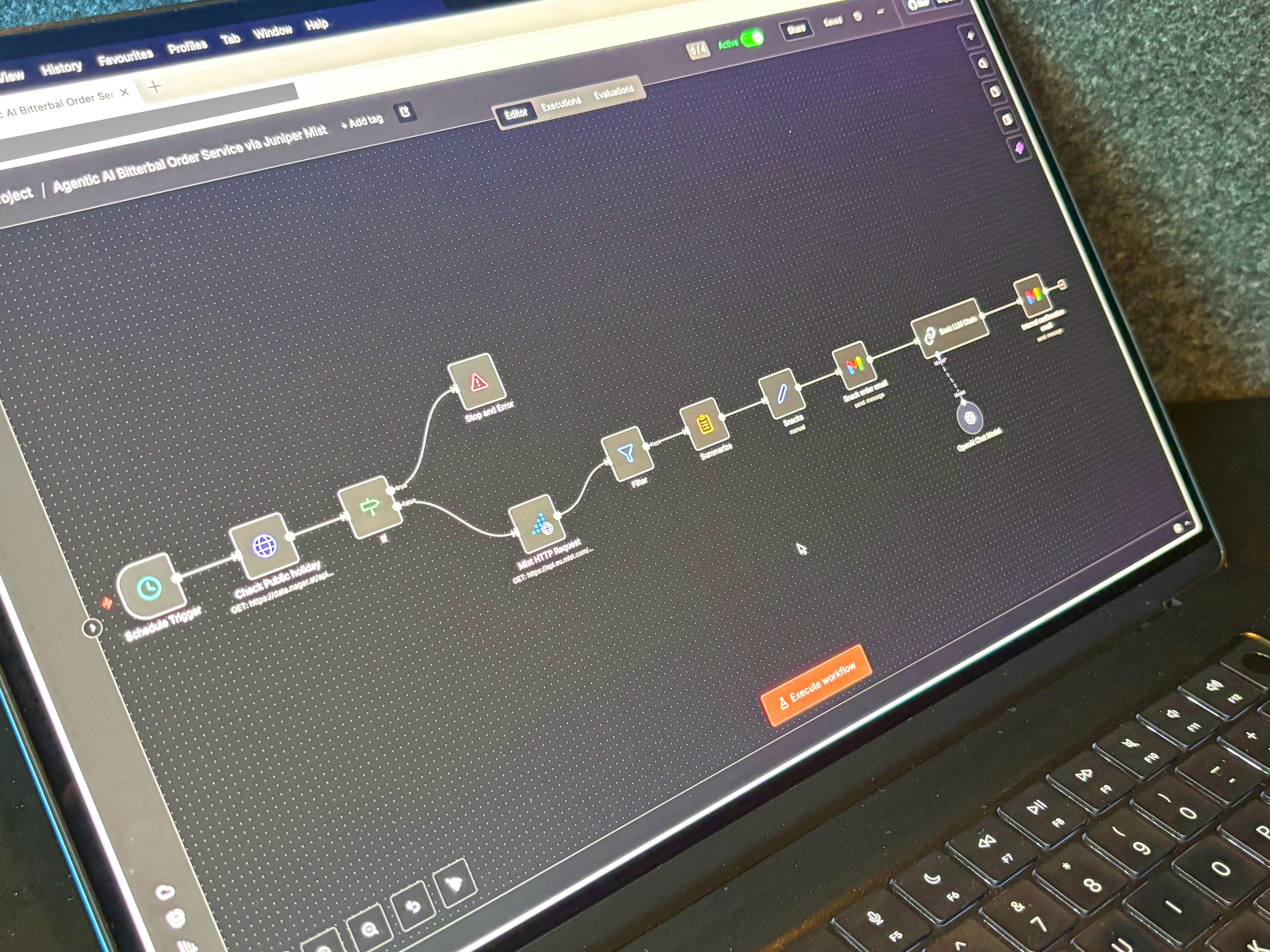
That is how our Agentic AI Bitterbal Order Service via HPE Juniper Mist was born.
What began as a lighthearted internal initiative evolved into a telling example of how modern network infrastructure can be more than connectivity alone. It demonstrates how an open, API-driven platform such as HPE Juniper Mist lends itself to automation that extends well beyond traditional IT operations.
Network data as business data
In many organizations, the network remains a relatively closed domain. It functions, it is managed, but its data largely stays within IT. HPE Juniper Mist breaks with that paradigm. The platform is cloud-native, fully API-accessible, and designed for integration.
In our case, we use real-time insights from the wireless network — specifically the number of active clients on a Friday afternoon — as an objective indicator of office presence. That data forms the basis for an automated snack order, calibrated to the actual number of colleagues onsite.
This is not mission-critical automation. But it is a pure example of how network data can directly feed a business process, without manual intervention.
The infrastructure provides not just connectivity, but context.
From automation to agentic behaviour
What makes this application noteworthy is that it goes beyond executing a static, predefined task. The workflow responds to current conditions, dynamically adjusts volumes, and automatically generates an internal confirmation message explaining the order.
In that sense, the system does not merely run a script; it acts based on live data and produces contextual communication. In contemporary terms, this is agentic behaviour.
It may sound disproportionate in relation to a bitterbal order. Yet it reflects a broader shift. Organizations increasingly seek ways to make operational processes more intelligent, autonomous, and data-driven. An open network platform enables precisely that.

HPE Juniper Mist as a modern platform
The essence of this story is not the snack. It is the platform behind it.
HPE Juniper Mist is built as an open ecosystem. Through well-documented APIs, organizations can unlock network data, combine it with other sources, and integrate it into existing workflows. This significantly lowers the barrier to innovation. There is no need for lengthy custom development projects or complex middleware layers — integration is achieved through standardized interfaces.
That openness is essential. In an era of hybrid and dynamic IT environments, infrastructure must adapt to processes, not the other way around. A modern network platform should facilitate automation rather than constrain it.
The bitterbal use case offers an accessible illustration. Yet the same architectural principles apply to far more consequential domains.
Inspiration for IT Ops and Sec Ops
Consider capacity management. If the number of concurrent wireless clients increases structurally, the same real-time network data can automatically trigger analysis or expansion proposals. Or take security operations: anomalous device profiles could initiate automated risk assessments and escalation workflows.
Weekly reporting on network experience, firmware compliance, or location-based trends can be generated dynamically and enriched with AI-driven interpretation. Not as static exports, but as contextual insights aligned with the current state of the environment.
The underlying mechanism remains consistent: the network delivers reliable, real-time data; the platform exposes that data; automation translates it into action.
More than connectivity
The value of a modern network platform is not limited to performance or stability. Those are prerequisites. True differentiation emerges when infrastructure evolves into a strategic data source that actively informs business processes.
This requires openness, standardization, and seamless integration capabilities. HPE Juniper Mist positions itself firmly within that domain — not as a standalone networking product, but as a foundation for broader digital automation.
That our first tangible application results in guaranteed Friday afternoon snacks is almost incidental. The real outcome is that the network has proven itself as a fully-fledged component of an intelligent, automated ecosystem.
And that development extends well beyond the bitterbal.
Our team is ready for you
Do you want to know more about this topic? Leave a message or your number and we'll call you back. We are looking forward to helping you further.