


In 2025 identity-related breaches accounted for 80% of cyber incidents, according to reports from CrowdStrike and Okta, making zero trust not just a buzzword but a necessity. Zero trust is often misunderstood as a collection of network controls or access technologies. In practice, zero trust is an architectural approach to access decisions, and identity sits at its core.
As users, applications, and workloads move across cloud and hybrid environments, identity has replaced the network as the primary control point. Zero trust formalises this shift by requiring every access request to be evaluated based on identity, context, and policy, rather than implicit trust derived from location.
What zero trust really means
The zero trust model removes the assumption that anything inside a network boundary is trustworthy. Instead, access is continuously evaluated based on who or what is making the request, what they are trying to access, and under which conditions.
The US National Institute of Standards and Technology (NIST) defines zero trust as an evolving set of cybersecurity paradigms that move defences from static, network-based perimeters to focus on users, assets, and resources instead.
This definition highlights a key point: zero trust is not a product. It is a decision-making model. Every access request must be verified explicitly and enforced consistently.
Identity as the primary decision input
In a zero-trust architecture, access decisions are made by a policy decision point and enforced by a policy enforcement point, with a control plane coordinating policy and telemetry. Identity feeds directly into that decision logic.
Identity provides answers to fundamental zero-trust questions:
- Who or what is requesting access?
- How confidently has that identity been verified?
- What access should that identity have at this point in time?
- What risk signals are associated with the request?
Without strong identity controls, zero trust cannot function. Network controls alone cannot determine whether a user should access a SaaS application, a cloud workload, or sensitive data. Identity provides the context needed to make those decisions meaningful.
This is why Gartner consistently positions identity as a foundational element of zero trust architectures, rather than a supporting component.
IAM as the enforcement layer for zero trust
Identity and Access Management (IAM) operationalises zero trust by enforcing access decisions at sign-in and during use. Where traditional IAM focused primarily on whether a user could authenticate, zero trust IAM focuses on whether access should be allowed at that moment, based on identity, context and risk.
IAM enables zero-trust principles through:
- Strong authentication, including MFA and risk-based controls
- Least privilege access, limiting entitlements to what is required
- Conditional access, where context, such as device posture or risk level, affects decisions
- Continuous visibility, ensuring access decisions are logged and traceable
Instead of granting broad access based on network presence, IAM enforces policy at the identity level. This allows organisations to apply zero trust consistently across SaaS applications, cloud platforms, and private systems.

Do you want to know more about Identity and Access Management? Read the article What is Identity & Access Management (IAM)?
IAM, PAM, and IGA in a zero-trust model
In a zero-trust architecture, Identity and Access Management (IAM), Privileged Access Management (PAM), and Identity Governance and Administration (IGA) work together to ensure access decisions are accurate, enforceable, and accountable.
IAM controls how identities authenticate and request access, and how that access is enforced across applications and services. PAM focuses on privileged access, such as administrative roles and high-impact permissions, where misuse or compromise has outsized consequences. IGA provides governance by ensuring access rights remain correct over time through approvals, reviews, and auditable processes.
In a zero-trust context, PAM is critical because privileged access represents the highest risk. Standing administrative rights undermine zero-trust principles by bypassing continuous evaluation. Controlling elevation and monitoring privileged sessions aligns PAM directly with zero-trust goals.
IGA supports zero trust by ensuring access decisions remain valid. If identities retain access they no longer need, policy enforcement loses meaning. Regular reviews, approvals, and lifecycle controls keep zero trust policies aligned with organisational reality.
From network-centric to identity-centric enforcement
Traditional security models relied heavily on network segmentation and trusted zones. Zero trust replaces this with identity-centric enforcement.
This shift reflects how access patterns have changed:
- Users access applications directly over the internet
- Workloads authenticate to each other using machine identities
- Devices move between networks without consistent trust levels
Identity provides a stable control point across these scenarios. Whether a request originates from a remote user, a cloud workload, or an API, identity allows the same policy logic to be applied.
Nomios believes identity-centric access is a key pillar of modern zero-trust architectures, particularly in cloud and hybrid environments.


Common zero-trust pitfalls related to identity
Many zero-trust initiatives fail to deliver expected outcomes because identity is treated as a dependency rather than the foundation.
Common issues include:
- Weak lifecycle management, leaving stale accounts and permissions
- Inconsistent policy between IAM, PAM, and network controls
- Overreliance on MFA without enforcing least privilege
- Limited visibility into non-human identities and service accounts
Zero trust does not eliminate the need for strong identity hygiene. It amplifies it. If identity data is incomplete or inaccurate, zero-trust policies become unreliable.
Identity as the control plane for zero trust
A mature zero-trust approach treats identity as the control plane for access decisions. Policies are defined once, enforced consistently, and supported by shared telemetry across identity, endpoint, and network controls.
This approach reduces duplication and improves clarity. Security teams can reason about access in terms of identity and policy rather than scattered rules across multiple technologies.
Nomios’ view aligns with this direction: identity is not just one control among many. It is the decision engine that connects authentication, authorisation, privilege, and enforcement across modern IT environments.
Why identity-led zero trust matters now
Zero trust adoption continues to grow as organisations respond to cloud adoption, remote work, and increasing identity-based attacks. In this landscape, identity is no longer optional infrastructure. It defines how access decisions are made and enforced.
Organisations that invest in identity as the foundation of zero trust gain clearer policy control, better visibility, and more predictable security outcomes. Those who treat identity as an afterthought often struggle to scale zero trust beyond isolated use cases.
Zero trust starts with identity, and succeeds or fails based on how well identity is managed.
Related solutions

![Highrise office buildings]()
Zero-Trust Network Access
Simple, automatic secure access that verifies who and what is on your network and secures application access no matter where users are located.
![Security experts for MDR services]()
Identity & Access Management
Protect and monitor user access in multi-perimeter environments with our IAM solutions.
![Man using smartphone bus stop]()
Privileged Access Management
Protecting privileged login data.
![Aerial view city streets]()
Secure Access Service Edge
An evolving network architecture requires a new security approach.
![Devops secops security engineer]()
Endpoint Detection & Response
Deliver continuous, comprehensive endpoint visibility that spans detection, response and forensics to ensure nothing is missed and potential breaches are stopped.





Do you want to know more about this topic?
Our experts and sales teams are at your service. Leave your contact information and we will get back to you shortly.


More about zero trust and identity


Identity management
Identity security in a changing IT landscape
For a long time, identity was the neglected part of IT security. User accounts, groups and permissions were necessary to keep systems running, but rarely the subject of strategic security decisions.


Richard Landman
Portfolio
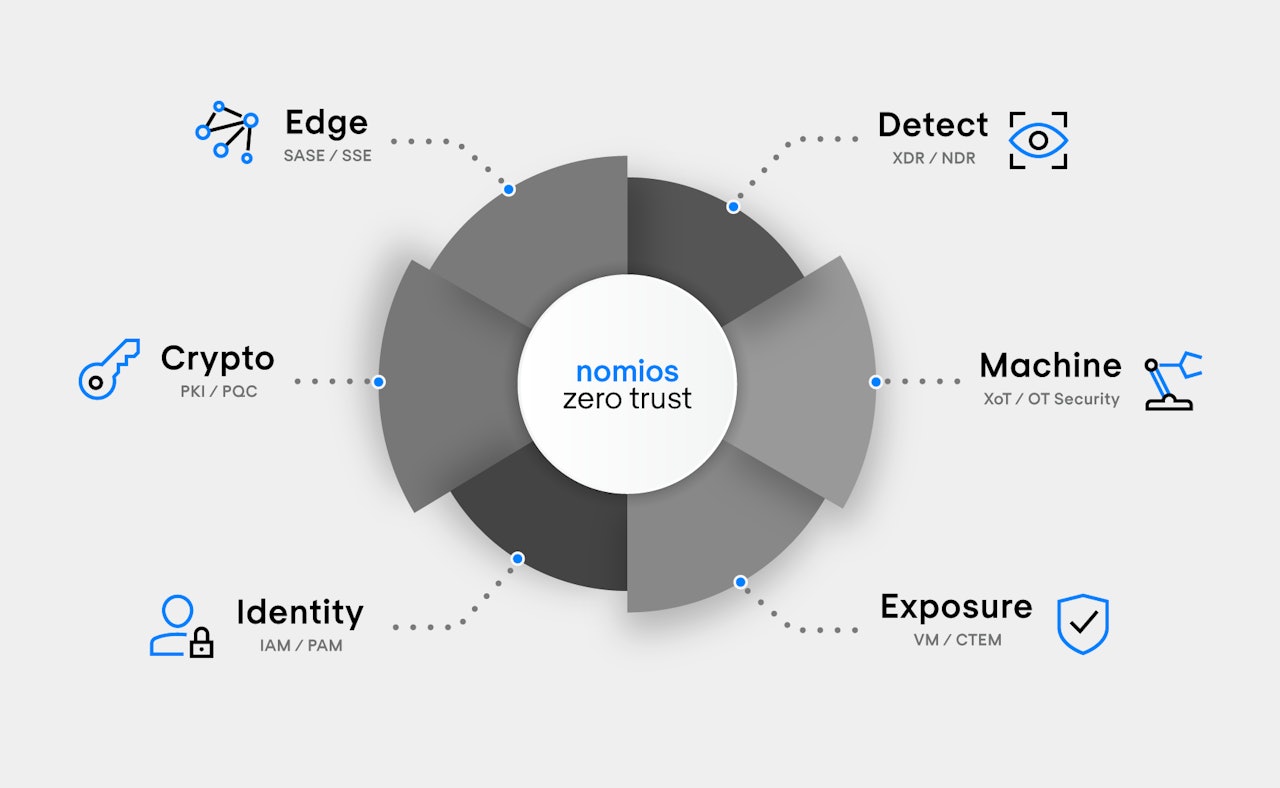
Nomios Zero Trust: one cybersecurity portfolio, six domains
Nomios is introducing a refreshed cybersecurity portfolio that doesn’t start with individual products, but with an architecture.
Richard Landman

Cybersecurity
Cybersecurity in 2026: Top 10 trends and challenges
Cybersecurity trends for 2026 cover digital sovereignty, quantum security, SSE and identity security, detection, compliance, and managing trust across complex environments.
Richard Landman